
My Research on the Mosta Old Church: From Designs and Measurements to a Baseless Accusation of Tomb Violation
“... within the crypt and ossuary of the Mosta Church, he violated tombs or burial sites ...”
— On 20 March 2014, the police falsely accused me of these macabre acts. I had entered the church crypt and ossuary solely for research purposes, equipped only with a camera and a measuring tape. I did not touch or damage anything; the church authorities were unaware of my visits, which occurred several times, including at night. The police only became aware of my presence from the photos on my laptop, following my arrest.
Throughout this blatant frame-up, the Archdiocese maintained a calculated silence, watching with passive satisfaction as I was cast into a sea of hatred and character assassination. Years later, they used that same silence to cover up an actual desecration in the same crypt — where one of their own destroyed mummified cadavers and discarded human remains like trash. Silence was weaponized to destroy an innocent outsider, then weaponized again to protect one of their own.

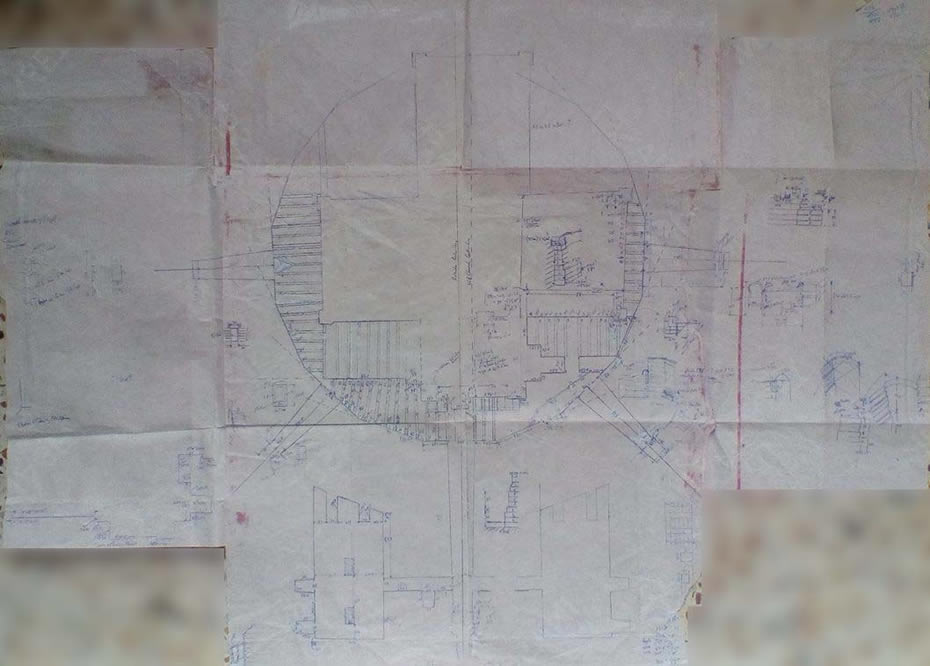
Plan of the Mosta Crypt and part of the ossuary.

Church plans by architect Tommaso Dingli.

Plan of the Mosta Crypt showing the tombs.

Plan of the Crypt and one of its warehouses.

Plan of the ossuary and part of the Crypt.
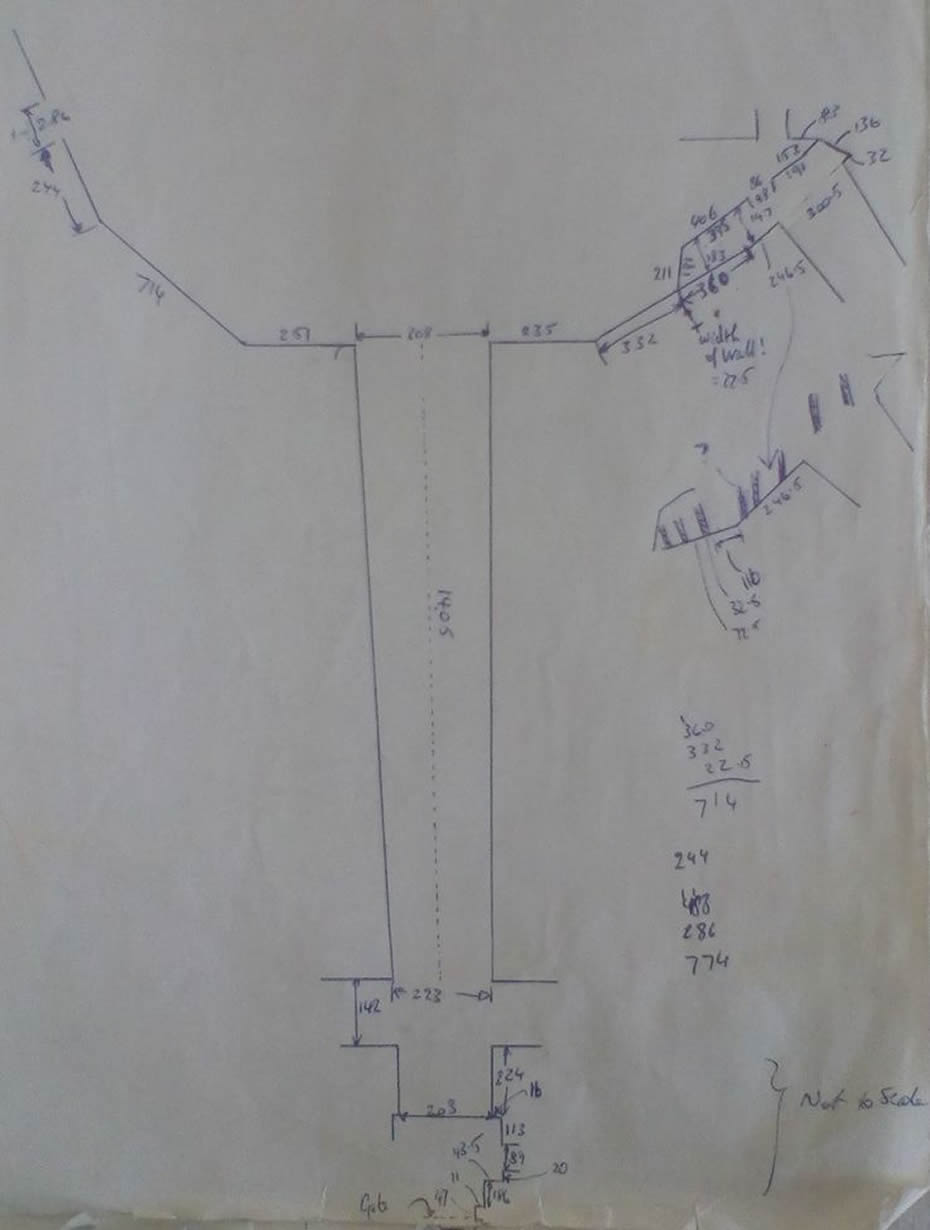
Plan of the Mosta Crypt’s main corridor.

Little remains of the original church in Mosta; however, sufficient evidence exists to approximate the location of the cross that once stood before it. This cross likely marked the site of an earlier church, documented by Inquisitor Pietro Dusina during his visit to Mosta in 1575. Additionally, the position of the painter who depicted the scene can be identified (both the cross and the painter’s vantage point are indicated by the small circles in the image on the left). Research confirms for the first time that the church in Mosta — likely the first commissioned from architect Tommaso Dingli — was constructed in the form of a Greek cross. While this sets it apart from his other Latin cross designs, subsequent publications continue to misidentify it as a Latin cross, a persistent and intentional inaccuracy that serves to obscure my original findings.

The door you see upon entering the ossuary once led to the sacristy of the old Mosta church. This photo gave rise to unfounded police reports, which the media sensationalized as the "desecration of a tomb within the ossuary." There is a significant difference between simply opening a door and opening a tomb. In an ossuary, there are no tombs — something that should be obvious, though apparently it wasn’t to everyone.
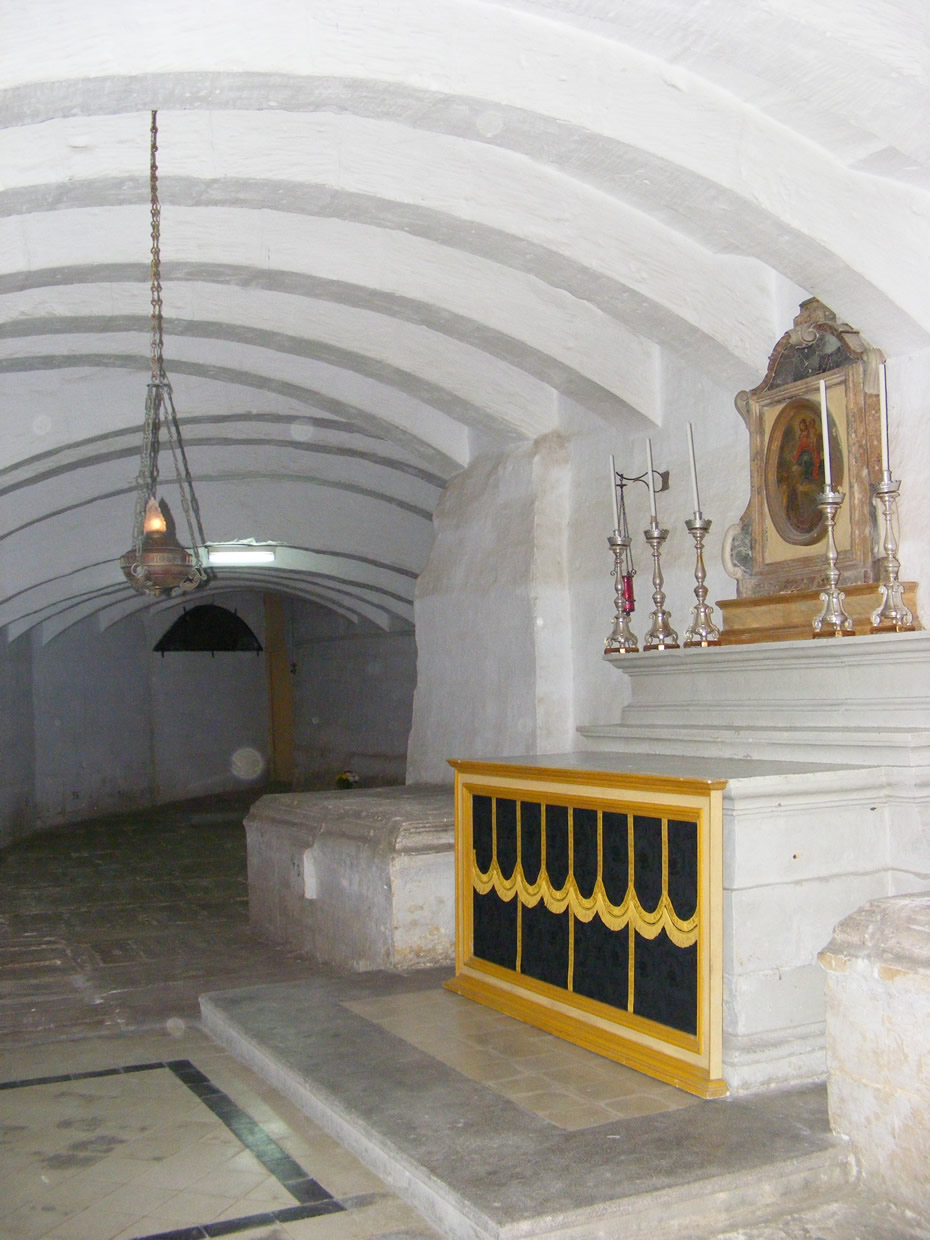
For research, you enter the crypt understanding almost nothing — the walls painted over, the sculpture that once crowned the church’s pilasters erased. To truly understand, you must step into the ossuary — the tall, slim yellow door — where the walls remain raw, untouched by paint. Ever wonder what those without cultural context take from research built on drawings and measurements alone? It becomes grotesquely clear when compared to my own experience: studying an ancient chapel in a cemetery, only to be accused by the police of desecrating tombs, or exploring the Delimara Fort, abandoned for years as a pigsty, yet accused of violating the mangers. Research, it seems, can be twisted into a framed-up spectacle — crafted by the corrupt police themselves.
This is a link to my article on Mosta’s old church, over 15 pages, published in the Feast Annal of 2017 — the fruit of this extensive research. Fearing character assassination, I even sent the editor a false photo of myself, worried he might not publish it if he knew my true identity.
Consider whether this research, along with the subdomain on my website dedicated to Mosta, could reflect what that sadist, fraudster, and habitual liar psychiatrist David Cassar called my "magical bizarre" way of thinking.
Another article I wrote — 30 pages, including on Mosta’s 1930s nicknames — was published in the Feast Annal of 2019. For a while, it became my last, as after reporting staff (a, b, c, d) in 2020 for abusively sleeping entire nights on duty, I faced retaliation (1, 2): I was confined to wards with limited permissions. My laptop was vindictively broken and withheld for months, and eventually, my mobile screen was damaged in a similar fashion.
Before this revenge, also in 2019, I submitted an article on Mosta’s statues and niches. Though late and too long for full publication at the time, its first part appeared in the Feast Annal of 2023, with the remainder expected in future volumes (second part in that of 2025, third part).
I also wrote an article on the 250th anniversary of the consecration of Mosta’s old church, published in 2024 in the annals of the Nicolo Isouard Band Club. Contrary to my intentions, it was heavily edited: sections were removed, parts made discontinuous, words altered or added vindictively, and the additional material I requested was omitted, rendering my work absurd.
For these reasons, I am now publishing the article here (link) in its original form. The editor simply denied me the opportunity to submit it to the other band club, even though my continuation on the statues and niches ultimately went unpublished that year without notice. Seeing work into which I had poured so much care and passion — on a subject that meant so much to me — reduced to silence and humiliation was devastating. As my mother used to say: “In-nies jgħallmuk” — people teach you. To make it even more despicable, this had to occur while I was being retaliated against with six back-to-back restrictions on my communication (5, 6, 7, 8, 9, 10).
From the Diary (translated from the original in Maltese)
3 August 2013: Around 5:00 PM, I go to try the keys for the back charnel house (I had made one that turned out too small, the wrong scale) and I find that there was one that fits in but wouldn't turn because it was too wide. I went home and shaved a bit off its width, and when I tried it, it was stiff at first, but I tried again and it turned. However, when I went to lock up again, I couldn't because the gate had been pulled inward by the latch that was against the wall. I was about to leave everything because I was afraid to lift the latch in case it wouldn't go back into place, but I managed to slip my hand in exactly and lifted it like it was nothing; I locked up and put the latch back in its place. It was about 5:30 PM.
13 November 2013: (This is when I opened the door forgotten by everyone in the sacristy of the old church). I had arrived with the van from work in the evening around 11:00 PM. I set the alarms for 2:20 AM and 2:25 AM; I stayed in bed a bit longer and went down around 2:35 AM. By the time I got to the door and headed out, it was about 2:45 AM. I arrived at the charnel house as the 3:00 AM bell rang. I find a car parked right in front of the gate, but there was no one in it, and I had to leave the van a bit further back.
...As usual, I take a look at the three rooms; I turned on the light at the opening outside the ossuary up to the altar. I open the door of the ossuary and start clearing things out; I remove the wire, that thing like a piece of a small cart, and a piece made of three pieces of wood. There was the candle holder which I managed to move against the wall toward the door I entered through, and there were two small pieces of iron that I threw to the side on the floor.
I start removing the stones, which were limestone and quite heavy for their size. I had just removed the top two layers when I found a key that had a part of it broken. I continue removing [stones] and reach the bolt/lock mechanism (sallatura). I started trying to insert the key I found, but it was too large and wouldn't go in, even when I tried to remove some rust it had on it. I had to remove another stone and bring the torch so I could see the lock better and perhaps see what was inside, but I saw nothing because there were cobwebs in the lock. I had almost given up and was about to go get the camera so I could make a key myself, but as I turned to get the camera, by the pillar, I found a key and a cuvetta (I think for the ossuary door). I try this key — it went in, I turned it, and it opened immediately without any problems at all! But the door only opened a little because behind it I could see there were corpses; I pushed it as much as I could and started taking photos.
I close it again and put the stones back against it, but I decided to take one of them that had a design as a souvenir, and in its place, I found another that fitted well. I find another stone with a design and placed both outside so I could take them out. I took the two stones out and placed them on the steps behind the gate that keeps the rain from entering. I was about to start putting the clutter back as it was when I noticed another stone with marble work and I carried that one too. I noticed it had concrete on it and I thought maybe it was something recent from the Rotunda, some part of a grave headboard. Anyway, I put everything back exactly as it was, and before I left, I sketched the arches as they are laid out inside the ossuary.
I struggled for a bit until I closed the ossuary door because, for a moment, the bolt got stuck inside and wouldn't move, and the wind was strong, seeming as if it wanted to blow the door open. Anyway, I closed it and also sketched the arches from the ossuary door to the altar.
As I was leaving the corridor, an old man passes by exactly as I had almost reached the side corridors, but he kept walking with his head down without noticing, while I quickly turned into the corridor on the side of the parish hall. I turned off the light I had on my head (I believe I had my hands over it as I was leaving) and waited in a sort of alcove, hoping to see him pass by the window, which he actually did. I was about to head out, but I decided to take a look out the window on the other side of the parking lot; then I told myself it’s better to head off and I left through the gate — there was no one there, it was exactly 4:07 AM.
I started carrying the stones into the van, all three of them. I closed up, and as I was coming back, I see the same old man arrive at the corner of "il-Gurbell" and he seemed to stop and wait. Anyway, I arrived, parked by the trees, and left the stones in the van. My shorts were full of dust and I had even stained my white shirt. I washed my hands and feet, brushed off the shorts and shirt, and downloaded the photos onto the computer. At 5:08 AM, I heard my mother wake up. They had called me the day before saying the kitchen tap in the upstairs flat had been left open, and at 8:00 AM I went to fix it. It turned out the internal part had come loose, and I finished it quickly.
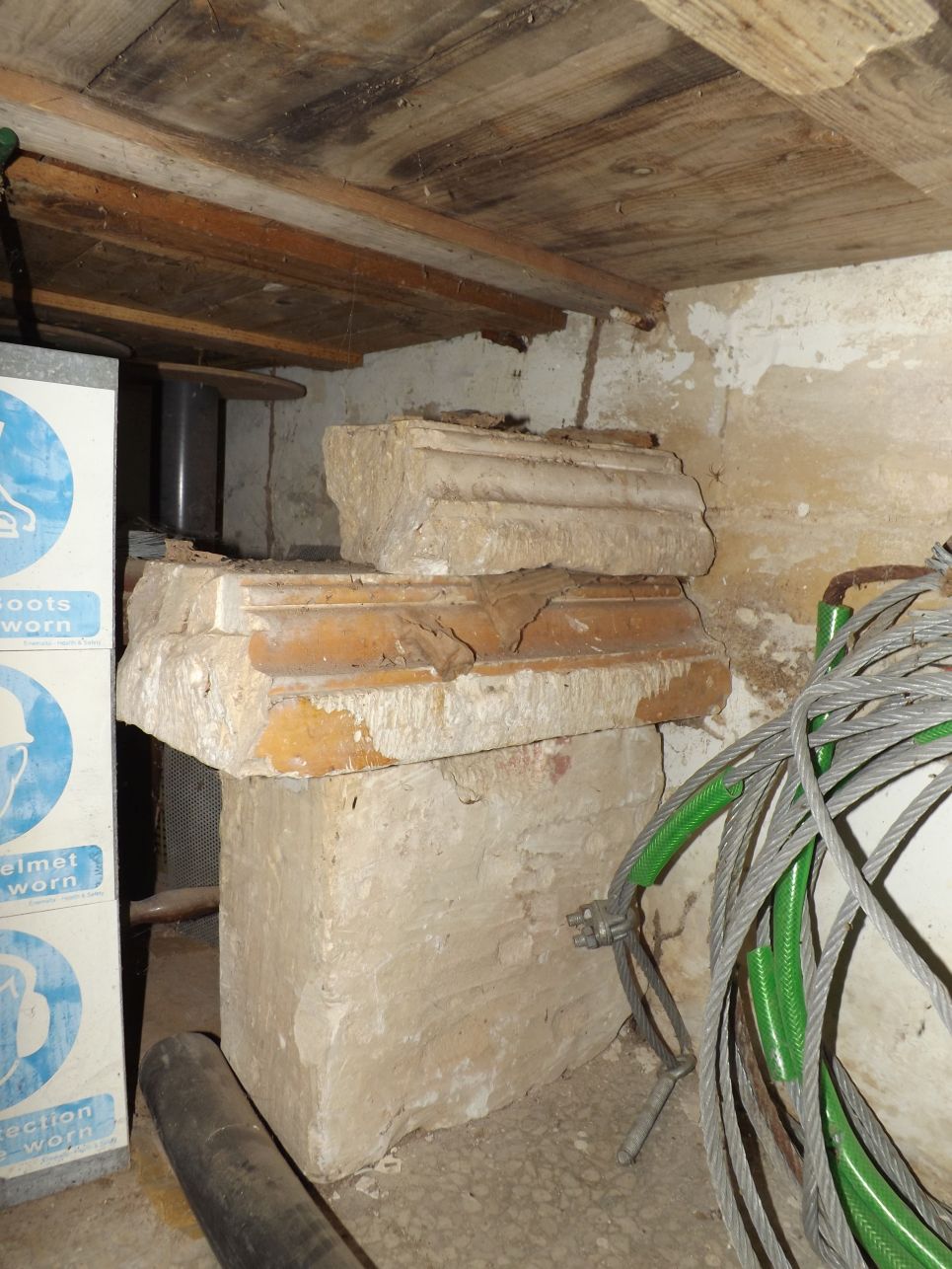 These are two of the three coralline limestone (tal-qawwi) stones I had found in the ossuary I referred to earlier, which I had taken home to study in peace (the other one was insignificant because I think it’s recent, containing some marble and concrete). If you go and see the desecration they’ve carried out in the ossuary recently when they cleared out more than half of the corpses and junk / imbarazz (see the photos below), I think these limestone blocks would have ended up among the rubble and trash.
I am ready to give them back to the Church provided they accept to take up the flooring of the Rotunda where the old church used to be and excavate it. Under this floor, there are very likely several stones — probably including those with original carvings — if you consider that to manage to demolish it within a week, they must have thrown a lot of its stone right down there instead of wasting time hauling it outside. Once the excavation is done, the Rotunda floor could be reinstated as it was, while we would have a museum with the remains of the old church underneath.
Above all, we would have something unique in Malta: a church within a church. (Since the floor of the old church was lower than that of the Rotunda — about 120 cm or more according to my research — and there is even more depth because the graves were dug beneath its floor, meaning there would be enough height for one to enter and visit the remains).
I had made this suggestion to the Archpriest back on December 8, 2011 — the feast of the Immaculate Conception — during the transition from Archpriest Mario Tong to Albert Buhagiar. I personally posted documents with this idea at the Archpriest's house, but I was never contacted. They couldn’t care less.
If you ask them for permission to go down there and you aren't part of their 'inner circle' or if you’ve long distanced yourself from them, they have the audacity to tell you: "No one enters in there." You write to the Archpriest to research the archives and he ignores you and doesn’t reply. Imagine people lacking culture like this — how would you ever find one of them to stay there, open up for you, and wait for you to measure and re-measure? Before a minute passes, they tell you to hurry up because they want to close. They discourage you before you’ve even started, just so they don’t look like the presumptuous fools they are; they’ve been there their whole lives and never discovered a thing. (The irony is that these people are given the 'Gieħ il-Mosta' award, can you believe it? While they call you 'mental,' 'crazy,' or mockingly say, "Go ahead, see if you find a Punic tomb down there.")
I could have instead made keys for where they keep the jewelry and valuables and become rich off the back of the Church — dragging away everything they have at my leisure without them even noticing. Instead, at the risk of catching some disease and out of love for the village, I made keys for places that aren't so 'pretty' in order to make the village rich [historically], trying to discover something of its lost history. Dealing with all the limitations I faced — stuck in the hospital trying to decipher measurements and sketches that the Police had confiscated for a long time, and which I had taken hurriedly in the middle of the night about four years prior — one can reach their own conclusion as to whether I managed to achieve my goal.
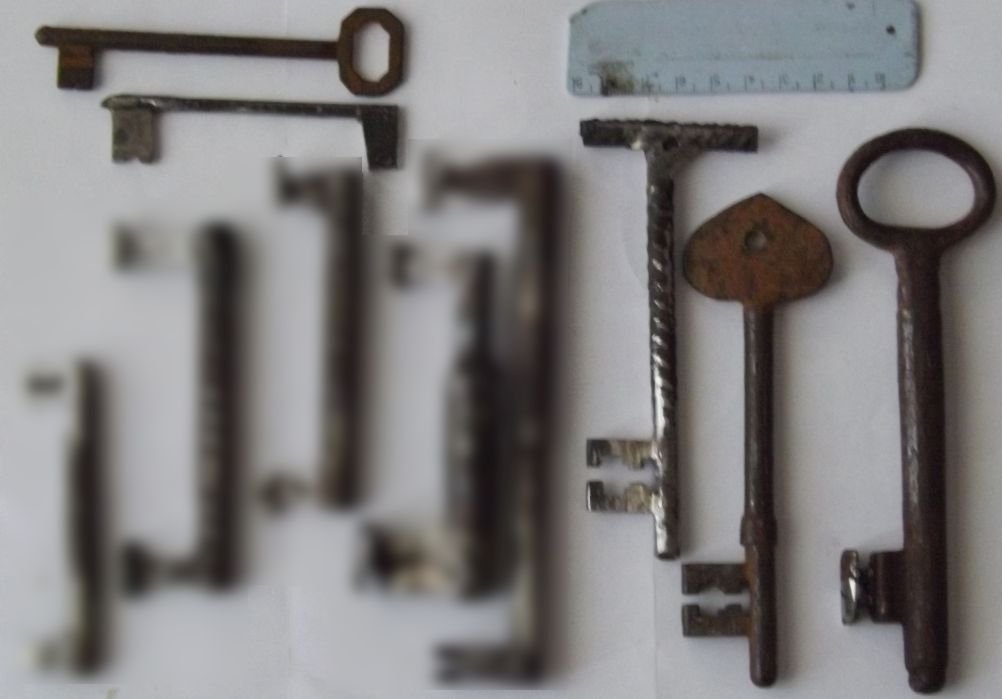 The blurred ones are keys that I made (blurred so that no one gets tempted and they end up having to add another mountain of cameras to the ones they already installed); the ones not blurred are others I either made or found in the ossuary and made copies of. Those two at the very top are for the door that leads into the ossuary, while that large one on the right I found myself while removing the coralline limestone blocks that were blocking the door to the old sacristy (I don’t know where it might lead). The two next to it (one of which is a copy I made and never had the chance to test on-site) are for the door of the old church’s sacristy. While I was confined in the hospital, the Archpriest at the time, Rev. Albert Buhagiar, came to see me a couple of times; I told him about these keys which I’d had to hand over to the Police upon my arrest, and he contacted the Police to recover them.
After I published the aforementioned article in the 2017 feast annual, his successor, Rev. Sebastian Caruana, and the bunch of uncultured 'amateurs' he surrounds himself with seemed to wake up. Seeing that I had entered the ossuary unscathed — despite rumors that the last two people to enter nearly died from a mysterious disease — off they went, scurrying down to see what they could find.
They arrogantly chose to 'clear out' the ossuary, causing total devastation to the remains, many of which were naturally mummified. A village’s heritage was destroyed once and for all. It is telling that, had it been otherwise, they would surely have issued a statement denying or 'clarifying' these serious public allegations. This group of uncultured amateurs couldn't care less about the relatives they may have buried there, which raises even greater concerns about the safety of Mosta's patrimony under the control of those with such a mindset.
During those times, I used to go out on leave, and I confirmed this when I visited the crypt (kannierja) when it was open on November 2, 2019, All Souls' Day. These are emails from 2019 that I sent via a third party to Archpriest Caruana (because if I write to him under my own name, he ignores me like a savage) trying to find out from him what might have happened to them [the stones / remains] — see also other emails further down where I reported this desecration. One of the members of this same clique of 'cultured amateurs' had, years ago, cleared out the Oratory of the Sacred Heart and threw away a heap of old photos and documents. Had it not been for Dr. Xuereb, who lived opposite and tried to save what he could while the garbage truck was passing — with everyone in a rush to hurl whatever they found into the back — these too would have ended up in the trash.
These are photos I took in the ossuary in the middle of the night, surrounded by naturally mummified corpses that you’d imagine were trying to speak to you, pleading for mercy.
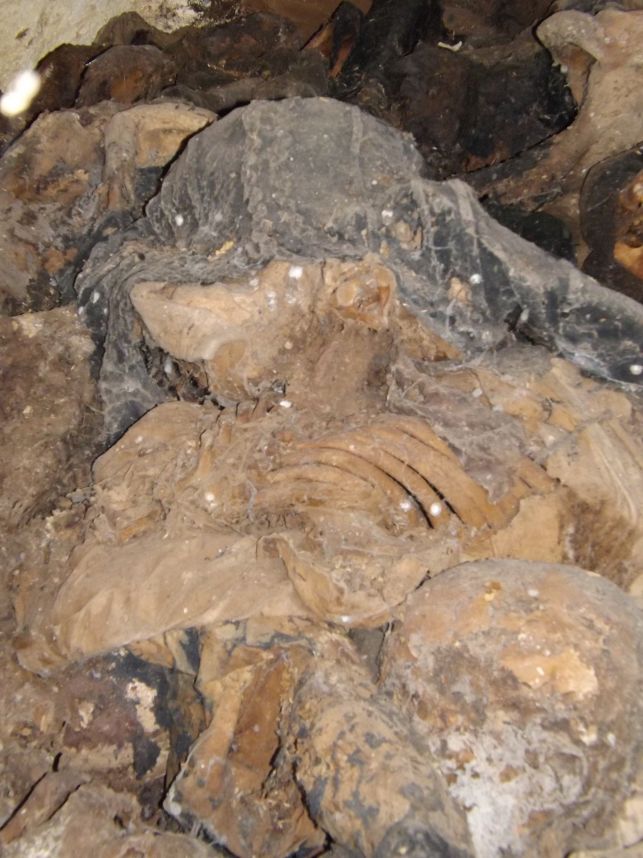 A woman or a girl with her hair in a braid. I took this photo from the street through a small opening that existed at the time in a window facing the Parish Hall side.
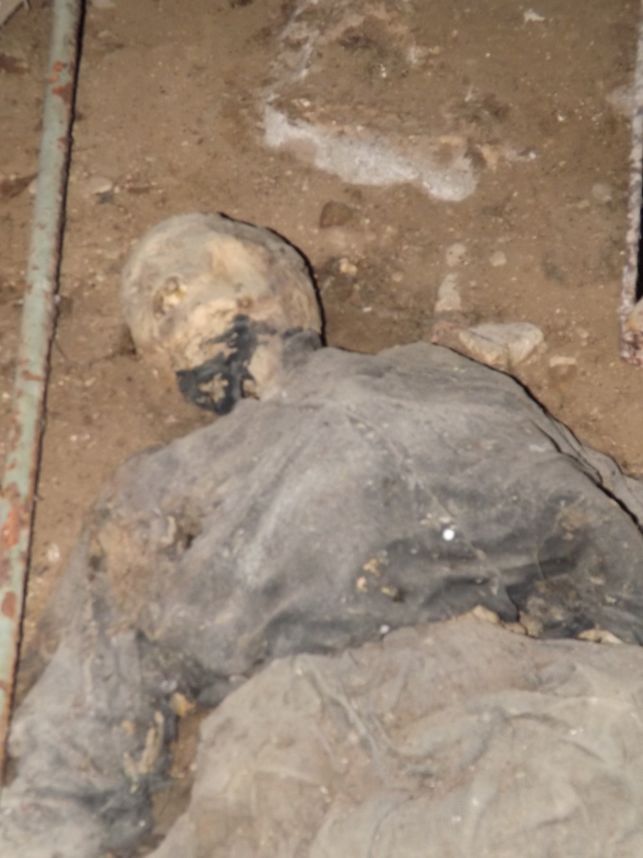 Although it could be a woman, it might have been a man — a member of a confraternity, shrouded in the muzzetta (ceremonial cape) of the brotherhood he belonged to.
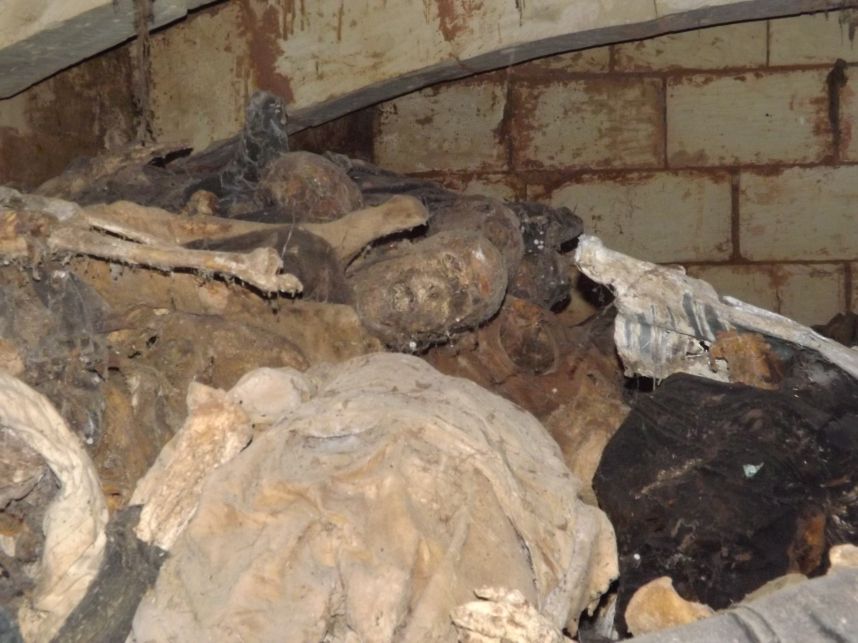 Part of a hand and a face still in a good state of preservation, naturally mummified.
 Another naturally mummified corpse.
 ...and another, among so many others, now destroyed once and for all.
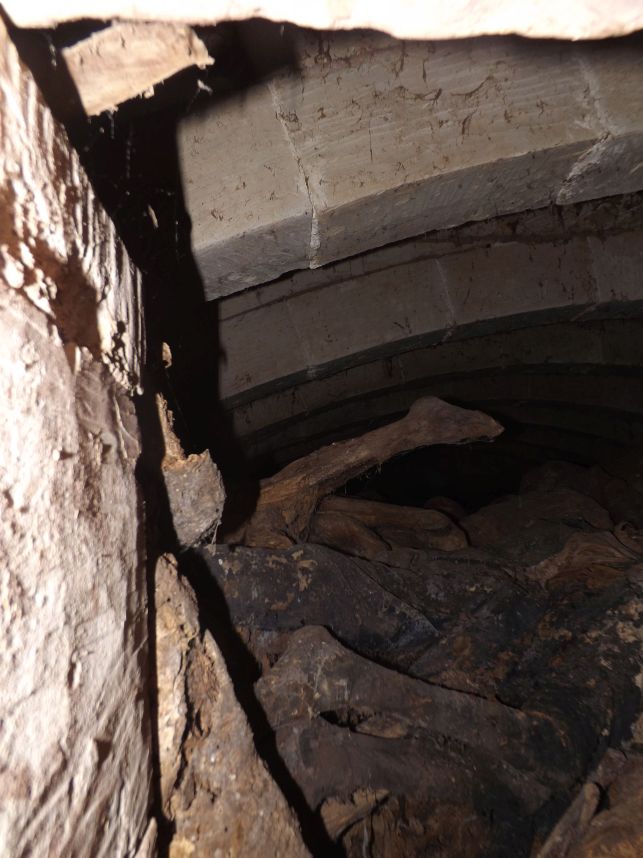 This is a photo of what used to be the sacristy of the old church, from the little I managed to peak through the door, because behind it was full of corpses that over time had slid down and ended up behind the door. Today, everything is destroyed since they cleared out a large part of it. Notice that bent leg in such a good state of preservation; imagine what the rest of it was like.
My grandfather, Kola Grech, whom I am named after, died on January 9, 1970. He would have been exhumed after two years, around 1972, just before the crypt was closed off completely in early 1974. I suspect this might have been his body, because my father used to mention that he had become so bent — like a hook — from a lifetime of splitting stone with a sledgehammer in the quarry, that they had to put a pillow under his head in the coffin to keep him from rocking back and forth.
I had such high morals that I left everything as it was; I didn't try to be intrusive and open the door further to perhaps see my grandfather’s face. Others came after me and destroyed everything — that is the villainy of it — but they get the applause, you know how it is. Anyone who had relatives in there, I suggest they go and pray at the Magħtab landfill instead. It is impossible that the thousands of corpses that were in there were stuffed into the few graves that might have remained empty in the crypt. This gravedigger they hired perhaps kept the skulls, legs, and large bones of a few lucky ones; the rest went into the rubbish skip.
These corpses — heritage so priceless that displaying them in a glass case would truly make you feel close to the Divine and make you realize how man is nothing, for when the Creator calls, nothing remains of you — I am led to believe that for the most part, they are gone forever. They cleared a large part of the ossuary around 2018–2019 (after I had written the aforementioned article in the 2017 feast annual, they seemingly 'woke up' and decided to go down there to see what was there, and quickly came up with a 'brilliant' idea: to clear out everything ... another priest who is involved with the feast decorations wanted to turn it into a warehouse for the street decorations). They survived the fury of the war, only to meet their end as a result of the ignorance of this bunch of 'Professors' and amateurs. No one from the Council or those responsible felt a sting of conscience over this desecration.
From the depths of Ta' Frankuni [Mount Carmel Hospital], I had to take it upon myself to report this so that perhaps justice could be done for these poor souls: to the Burials unit, to Heritage Malta, and to the Police in 2024. But it was all in vain, because for those 'big heads' (the powerful), justice does not exist, and we even give them the 'Gieħ il-Mosta' award; whereas for the little man, they invent accusations and frame him as they did to me. Around October '25, amidst so many psychiatric abuses, I wrote to Archbishop Charles Scicluna himself, among many other priests, taking the opportunity to draw a comparison between this desecration and what I had to endure — his absolute silence is deafening, while I have continued to be victimized as a consequence (11, 12, a, b, c, d). He didn't want to lose another priest from the last four dozen he probably has left.
I entered that place to conduct research, simply taking photos and measurements of the site, and I left everything as it was. Despite this, I ended up accused of the violation of graves — a blatant assassination of my character. Others entered and saw them as mere 'clutter,' good for nothing but to be stuffed as much as possible, in a savage manner, into the few graves that remained empty, and perhaps others were taken out of the crypt, if not thrown out with the trash. Now ask yourself: who committed the violation of the graves? But as they say, everyone has their own luck.
The Mosta Crypt Scandal: How Church Authorities Ignored a Path to Compromise
The Silence of the Shepherds and the Desecration in Mosta
On May 5th, I formally reached out to the Church authorities in Malta via email to address a history of character assassination, administrative negligence, and the direct destruction of our local heritage.
The core issues outlined in this correspondence trace a direct line from past institutional malice to current administrative misconduct:
- The 2014 Frame-Up Under Archpriest Albert Buhagiar: Following my efforts to document the remains of the Old Church of Mosta, I was falsely accused and framed for the "violation of graves." Despite knowing the truth — that I had neither stolen nor disturbed anything — Archpriest Buhagiar and the Church authorities maintained a calculated, strategic silence. They weaponized this silence to allow the total assassination of my character, ensuring my vindictive confinement. This was done in particular as a retaliation — so much salivated for by the church enthusiasts — because I had dared to enter the church they treat as their exclusive space, driven by an artisan's passion they permit no one else to interfere with.
- Current Negligence Under Archpriest Sebastian Caruana: In a striking display of hypocrisy, the very act I was falsely accused of in 2014 was later committed on a massive scale by the Church itself. Following the publication of my research on the Old Church of Mosta, the parish administration and local "enthusiasts" went down to the crypt to see it with their own eyes and decided to clear out the historic ossuary. Naturally mummified remains — a rare and priceless part of Mosta’s heritage — were treated as mere clutter, mostly ending up shattered and unceremoniously crammed into vacant graves or discarded as refuse.
- The Complicity of the Hierarchy: Both Archbishop Charles J. Scicluna and Auxiliary Bishop Joe Galea Curmi were fully informed of these abuses. Instead of investigating the destruction of heritage or correcting the injustices of the past, they chose total inaction, effectively making themselves accomplices to a cover-up to protect high-ranking members of the clergy.
A Fair Compromise Ignored
Rather than initiating an immediate public escalation, my May 5th email offered the Church a clear, constructive path forward through four specific proposals:
- Acknowledgment of Injustice: Break the silence on institutional hypocrisy and publicly address the misuse of authority, in particular regarding institutional corruption and psychiatric malpractice.
- Access to the Church Archives: Grant me free and unencumbered access to historical records — as they already do with others and as should be the norm — to allow for my possible research and the publication of unexamined aspects of Mosta's history.
- Excavation of the Old Church Remains: Initiate a targeted, non-disruptive night excavation under the Rotunda flooring to uncover, preserve, and showcase the architectural remnants of the Old Church.
- Restoration of the Titular Statue: Commission a reproduction of Salvatore Dimech’s original, beautiful titular statue to rectify its historic loss and honor the ancestors buried beneath the church.
The Deadline Has Passed: Formal Escalation to the Holy See
Following the passing of the June 26th deadline — marking the 12th anniversary of the vindictive legal sentence handed down against me by Magistrate Carol Peralta — I chose to wait an additional two weeks. I held back further action, holding onto a final, lingering hope that a shred of conscience or institutional pragmatism might compel the Maltese Curia to act. This grace period yielded nothing but continued, cold arrogance.
If I had bypassed the path of compromise and escalated these matters immediately to external bodies years ago, the raw truth of the ordeals I suffered might have gained widespread coverage much sooner, rather than allowing myself to remain forgotten within the walls of a psychiatric facility. By attempting to negotiate with an institution that understands only dominance and absolute control, I merely delayed the inevitable. But at the end, enough is enough.
Just as the Archdiocese has a vested interest in concealing its administrative failures, its character assassination through Church-controlled media, and the illegal handling of historic remains, I have an unalterable vested interest in completely clearing my name, standing as a defender for the desecrated ancestors of Mosta, and ensuring that the four cultural and moral rectifications I proposed are brought to fruition.
With the boundaries of diplomacy then officially closed, on July 11, 2026, there remained no other option for me but to formally elevate this entire matter directly to the highest authorities in Rome: the Vatican Dicastery for the Doctrine of the Faith, the Secretariat of State, and the Apostolic Nunciature to Malta.
The comprehensive, unabridged text of the formal dossier transmitted to Rome has been permanently published to this site for international public review:
👉 [Read the Full Escalation Dossier Here]
A Final Note on Institutional Accountability
The leadership of the Maltese Church operates under the dangerous illusion that their senior administrative status grants them absolute immunity. They should look closely at Rome. On July 2nd, Pope Leo XIV and the Dicastery for the Doctrine of the Faith demonstrated exactly how swiftly the Vatican will act against defiance and disorder when they issued sweeping excommunications globally.
If the Holy See can move with such lightning speed against traditionalist clergy for matters of governance, it cannot logically or morally ignore a senior Archbishop and his Archpriests who have covered up systemic human rights abuses and physically desecrated the sacred remains of the dead in direct violation of state and Canon law.
The digital footprint is permanent, the formal canonical channels have been engaged, and the responsibility for the impending public fallout now rests solely upon the shoulders of those who chose the path of weaponized silence.
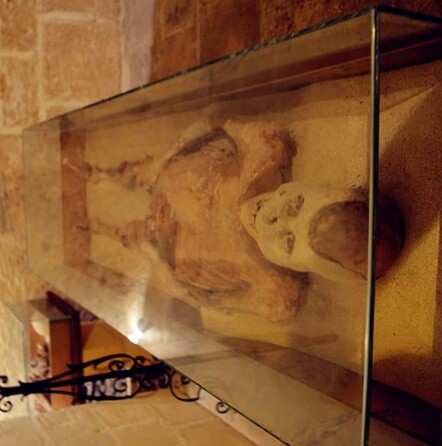 This is Padre Krispin at the Capuchin friary in Floriana, where they had the custom of mummifying the departed (which is why he remained with yellow skin instead of turning black like the ones we once had in Mosta, which were naturally mummified — see the previous photos). Despite him not being from Floriana, but from Gozo, the people of Floriana hold him in high regard and placed him in a glass case, among the few they managed to save from the destruction of the war. Yet we in Mosta had all that heritage of corpses and they destroyed everything, due to the ignorance of certain people (never underestimate the ignorance an ignorant person can produce). That is the villainy of it. See the video 'Mummies from Italy' regarding heritage on this same theme that they have in Sicily.
Question: Many have asked whether I experienced any supernatural phenomena after entering a crypt and an ossuary full of remains alone in the middle of the night.
Answer: I have to admit, leaving the warmth of my bed and my sleeping pets in the middle of the night was not easy. Although I was not particularly religious, I felt a certain fear rooted in the way we were conditioned from childhood by church doctrine regarding the afterlife. However, my curiosity and the hope of discovering something new about the history of my hometown recharged my adrenaline and gave me the courage to do it.
Once there, I tried to keep my mind occupied with technical tasks — taking measurements and photos as quickly as possible — to avoid letting my fears take hold. I did take photos of the remains, though in the total darkness of the ossuary, they were barely visible in the split second of the flash. It was only later at home that I would spend minutes staring at those images, wondering about their final moments and reflecting on the day it would be my turn to end up in that state.
After my first two visits, I remember experiencing sleep paralysis. I felt as though those souls had followed me home and were pressing on my chest, as if to protest my presence. I attribute this again to our early "brainwashing," as the sensation ceased once I became accustomed to those surroundings. In my imagination, I expected to be visited by my own deceased relatives buried there, but that never happened; consequently, I remain skeptical about the traditional afterlife.
However, throughout the many misfortunes I have subsequently endured, I began searching for a correlation. To my astonishment, I found so many dates that line up in strange, disturbing ways — birthdays, death anniversaries, ID numbers, and family events. It is as if everything was set in motion long before I was born (possibly the same with anyone else). Most incredibly, I found an overwhelming number of coincidences linked to one particular relative and her deceased child. Strangely enough, our families ended up detesting each other rather than showing the affection one would otherwise have expected. It reached such an extent that I even find myself imagining her praying to God, asking why He hasn't taken me as He did her child, or why the psychiatric medication has not finished me off yet. In reality, it is sometimes those you least expect who most desire your end, driven by a greed to inherit what you possess — a grim fate shared by many who find themselves trapped within the psychiatric system