
Animal Welfare Department Statistics: The Number of Roadkill Casualties in Malta


A stark reality: Around 2020, traffic accidents in Malta claimed roughly one animal life per day.
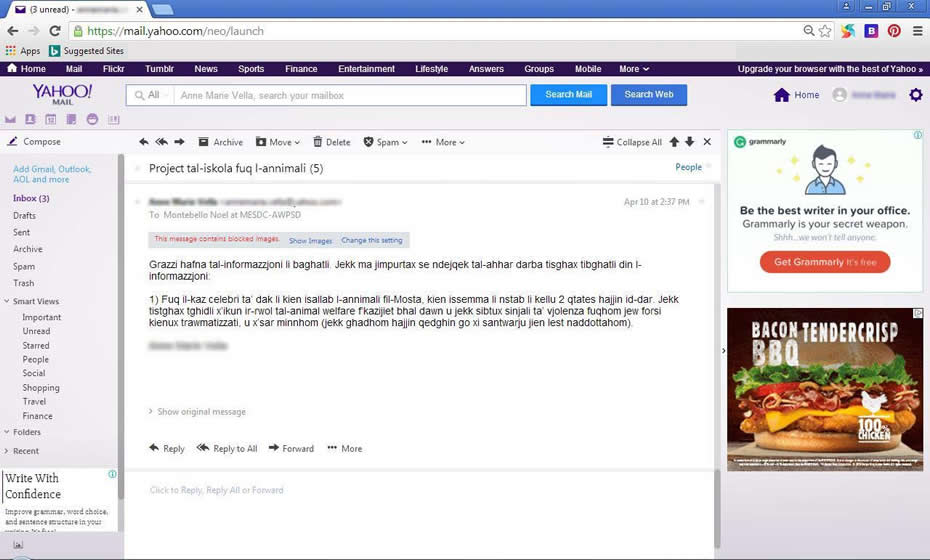
An email inquiry regarding the Animal Welfare Department's involvement in the Mosta animal crucifixions case, specifically concerning the three pet cats belonging to the accused (myself).
Email Inquiry
"Thank you very much for the information you provided. If possible, I would like to ask one final question regarding the following matter:
In the high-profile Mosta animal crucifixion case, it was mentioned that the accused kept cats alive at home. Could you please clarify what role the Animal Welfare Department plays in such scenarios? Specifically, were these cats examined for signs of violence or trauma? Furthermore, what became of them? If they are currently being cared for at a sanctuary, I would be willing to adopt them."
Analysis
This inquiry proved to be highly embarrassing for the authorities, resulting in complete silence. It raises a glaring contradiction: how can someone be accused of severe animal cruelty and killing, yet keep three pet cats at home without anyone bothering to examine them?
To put this into perspective, it is comparable to accusing someone of being a pedophile without investigating the welfare of the three adopted children living in their home. The police were evidently so convinced that I was innocent of any such mistreatment or killing that they did not even involve the Animal Welfare Department.
For their part, Animal Welfare took absolutely no initiative to examine my three pets — failing to check for illnesses, signs of stress, whether they were abusively declawed, or even whether they were tame or feral.
Fabricated Credit: Debunking Emanuel Buhagiar’s Involvement
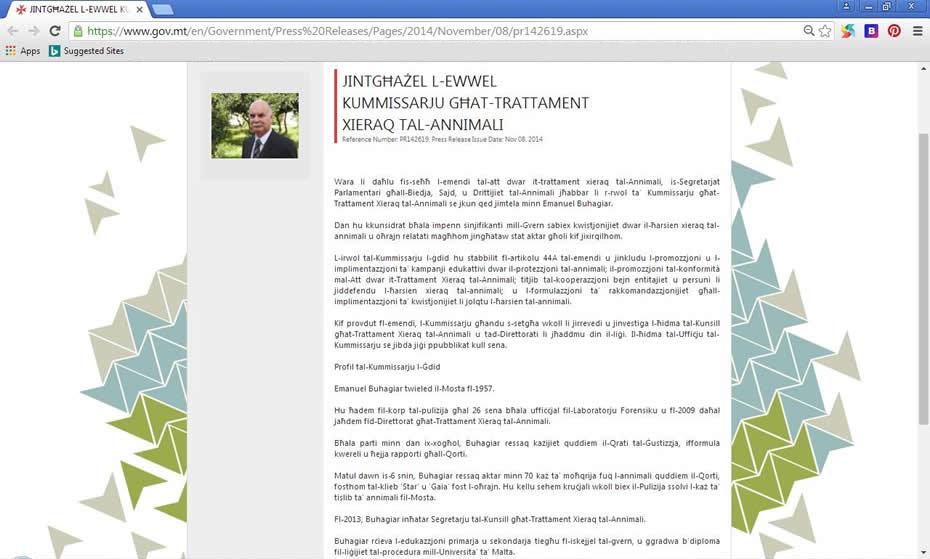
The Claim: "He played a crucial role in helping the police solve the Mosta animal crucifixion case."
This is entirely untrue — it is a blatant lie. In reality, he only ended up taking the credit because of a chain of events following my forced hospitalization. While I was confined there, friends and colleagues came to visit me. Based on details I managed to glean directly from the police during my interrogation, I confided in my visitors that the primary individuals who had raised suspicions against me were Jeffrey Galea and Louis Chetcuti. Word of this likely got back to Galea, who presumably complained to the authorities, prompting them to shift the narrative and attribute the breakthrough to someone else entirely — specifically, the then-Commissioner for Animal Welfare, Emanuel Buhagiar.
The police’s own actions expose this narrative. Following my arrest, they did not even bother to involve Buhagiar or the Animal Welfare Department to examine my three pet cats. The authorities were well aware that I loved animals and would never mistreat or kill them; they were simply framing me with unfounded accusations.
Furthermore, given the high volume of roadkill in Malta, the most Buhagiar could have logically concluded was that any animals involved must have already been found dead on the streets. It would make no sense to go through the immense trouble of hunting and capturing live animals when there is an unfortunate abundance of roadkill readily available, particularly on busy countryside roads.
Admitting that this Animal Welfare Commissioner had absolutely no involvement in what was being sensationalized as the country's worst case of animal cruelty would have been highly embarrassing for the authorities. To avoid uncomfortable questions and protect their narrative, they fabricated this claim of his "crucial role."
The Chain of Complicity: How the Cover-Up Continued Under Denis Montebello
If it seems difficult to believe that the Animal Welfare Department would completely neglect to investigate the pets of someone accused of severe animal cruelty, it is because they were wholehearted participants in this premeditated frame-up through their calculated silence. To understand the depth of this institutional failure, one only needs to look at the subsequent email exchange with Emanuel Buhagiar’s successor, Denis Montebello.
These emails perfectly illustrate a systemic issue in Malta: Montebello was not appointed for his dedication to animal welfare, but rather because influential connections gave him the necessary political backing — the kind of favors that leave an official permanently indebted to their benefactors.
The shift in his tone throughout the correspondence is highly revealing:
- The Facade of Authority: Initially, he attempts to project an aura of superior intelligence, ostentatiously signing off with his academic titles, "B.A., LL.D."
- The Deflection: He then tries to ridicule a student inquiring about a school project, desperate to deflect from and cover up the severe misconduct of his predecessor.
- The Trap: However, once he realizes he has taken the bait, he finds himself cornered and legally compromised. Lacking any logical arguments, he abruptly changes tactics and offers an in-person meeting at his office to handle the matter quietly.
- The Retreat: The moment it is suggested that he should instead meet directly with me to review the hard evidence, he cuts off all communication completely. He never reached out to me, nor did he ever invite me to present my side of the story.
Though the letters "LL.D." signify that Montebello is a qualified lawyer, he chose to discard his legal training. Instead of upholding the law by investigating and reporting these abuses, he became complicit by covering up his predecessor's actions — proving just how deeply entrenched this corruption is. Ultimately, this case serves as a stark reminder that in Malta, nepotism and political connections consistently triumph over professional integrity.
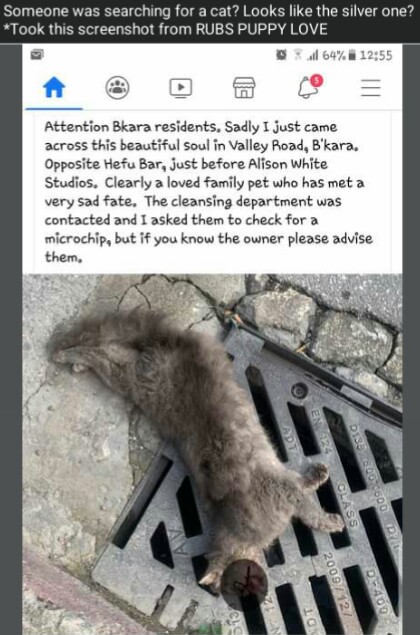
The image above illustrates the typical condition of a cat killed by an initial vehicular impact that lands on the side of the road. The body remains intact, unlike the severe disfigurement caused by being repeatedly run over by subsequent traffic had it remained in the middle of the road.
For further examples, search Google Images for "cat killed by car"
Media Complicity: How the Press Profited from a Fabricated Narrative
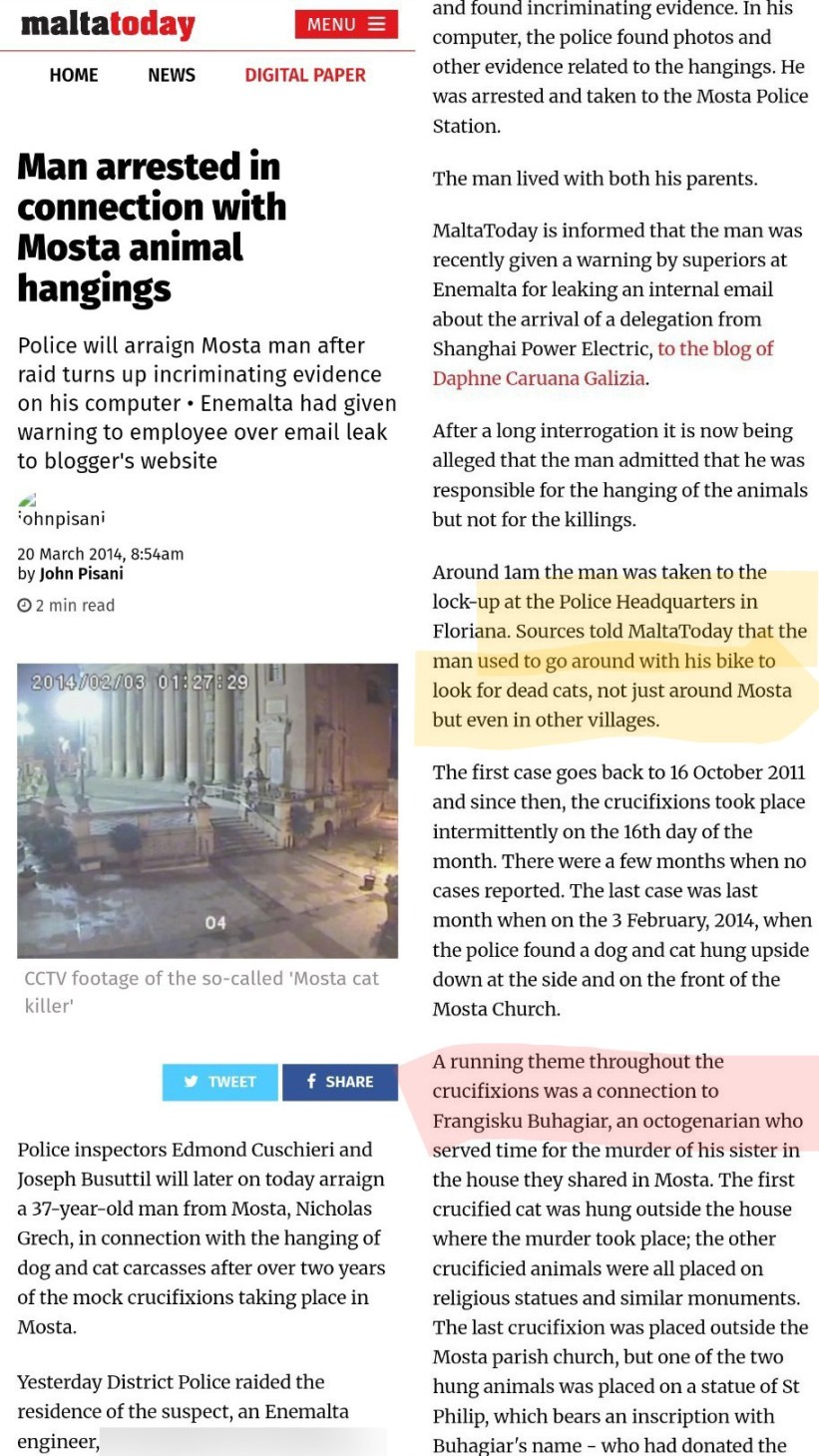
The media knew from the very beginning that I, Nicholas Grech, was not an animal killer.
If any doubt remains, the screenshot above — taken from a MaltaToday article published the day after my arrest — proves that journalists possessed inside information directly from the police confirming I had only used animals that were already dead.
Despite knowing the truth, the media deliberately chose to falsely brand me as a cat killer. They favored sensation over facts to fuel public outrage, driving up their web traffic and ad revenue. In doing so, they pocketed substantial profits at the expense of feeding blatant lies to their readers, inciting immense and unfounded public hatred, and viciously assassinating my character.
A textbook example of the "investigative journalism" served up by the media in a country as deeply corrupt as Malta.